On Lying Fallow

Screen Shot 2014-07-20 at 5.41.30 PM
What I like to do best in this blog is tell stories—preferably witty and arch ones wherein I prevail in battle against the forces of romantic villainy and chaos (or, if necessary, turn a defeat into a clever little anecdote which represents me in a sympathetic and nobly-heroic light). But in recent weeks, I’ve had no stories to tell because my one-woman Romantic Justice League has been languishing in idleness. I’ve been doing all sorts of Important Things; I’ve been Productive; I’ve upgraded my cable so I can watch Game of Thrones and True Blood which provide all manner of stimulation and provocation—but I haven’t had a date promising or maddening enough to write about in forever.

If I were a field of hay, I guess this would be my season to lie fallow. I seem to be in a mode that my friends refer to as “brain-on-a-stick”: lots of good mental and emotional work going on on top, complete indifference to the non-goings-on from the neck down. My boss and my résumé appreciate this state of affairs greatly. My own response is a little bit more mixed.

My low point came a couple of weeks ago, as I was in the throes of finishing a huge writing project—lexically huge at 13,000 words; psychically huge as I’d come to invest the piece with every bit of my professional and personal identity. I was intellectually distracted, short-tempered, harried. I was having hypochondriacal fits about mysterious goings-on with my teeth, my toe, my tongue (over-zealous tongue-scraping)—which was stupidly ironic as I was writing about psychosomatic illness. I wasn’t too tired, but only because I was generously sedating myself every night. I felt too bad to make it to salsa or the gym. I had a terrible cold. And my hair was kind of falling out, because—fun, new age-related change—I molt when I’m stressed. The writing was coming to a crisis: was I going to get this thing done, and finally be free of it after 3 years of research? was the world (well, at least the journal editor and two peer reviewers) going to welcome it? or was it the rantings of a complete madwoman? I really had no idea, but I just carried on, in a frenzy of miserable work.

I did a lot of this work in bed. They say that for good sleep hygiene you should only use your bed for two things, but since I was only getting one of them, artificially (um, still talking about sleep), and I don’t have a lot of surface area elsewhere in my very small apartment, the bed was drafted into service as office. So it was that on one recent Tuesday, around 8 am, you would have found me, en deshabille, hair tangled, no makeup, surrounded by laptop and drafts and notes scrawled on scraps of paper; my sinuses were draining energetically; my cough was, from a medical standpoint, healthily loose and productive—which means I was barking like a consumptive dog; I was slopping coffee as I pulled it distractedly from the night stand; there was ink on the pillow cases, molted hair and sriracha on the sheets, used tissues on the floor.

Coming back to the bed from the kitchen—forced to stop by a fit of coughing which demanded follow-up nose blowing, which resulted in more spilled coffee—I thought: huh, this is kind of a low point. (It wasn’t quite as bad as Tracy Emin’s installation, but on its way). What made it especially low was that I was aware of this disreputable disarray and, simultaneously, completely indifferent to it. Consumed by the drive to make my deadline and my own physical misery, part of me was horrified that I wasn’t more actively horrified by the squalor—and part of me was actually perversely gratified: See?? (I thought, in the editorial plural) We can be focused, unrelentingly productive, and triumphant over adversity after all!

In the midst of this episode, I’d get updates from one dating site or another—and never mind the truly unsettling number of unsuitable suitors—I’d catch a glimpse of myself in the mirror, disheveled and haunted, and think, now is not the time.

Which was a bit odd, because I obsess about dating a lot (Guys, don’t flatter yourselves too much. For contextL: I obsess about everything a lot; I’ve spent the past weekend alternately worried about such pressing business as my toe, my work, my weight, my hair, and whether or not I’m entitled to a new suitcase). To have no psychic energy to spare for hypothetical men was unusual, a rare break in the obsessive, self-absorbed clouds that usually shadow my mental landscape.

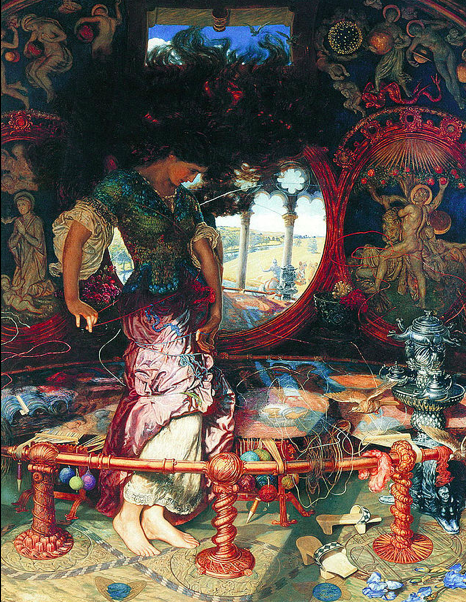
And then I realized, with a start: I’ve become the Lady of Shalott.

Everyone knows the story, from Tennyson’s narrative poem…or I’ll just give you the highlights here: A few miles from Camelot, a Lady lives alone in a tower. She spends her days absorbed in her weaving, and she can only look at the world as it’s reflected in a great mirror. She lives under a curse—we never learn whose, or the reason for it—and is forbidden to look directly at the world, or be in it at all. So she sits, and weaves, and looks at reflections of the world outside her tower: “I am half-sick of shadows, said the Lady of Shalott.”

Until one bright day, she sees something gleaming in the mirror—a knight, on his way to Camelot. And it’s not just any knight—it’s Lancelot, with gleaming armor, feathers on his helmet, noble carriage, coal-black curls. The man is, as Guinevere and Arthur would both agree, fatally perfect.

Overcome by beauty—of the whole world beyond the window, and, specifically, of this vision of masculine perfection—the Lady can’t help herself:

She left the web, she left the loom,

She made three paces thro’ the room,

She saw the water-lily bloom,

She saw the helmet and the plume,

She look’d down to Camelot.

Out flew the web and floated wide;

The mirror crack’d from side to side;

“The curse is come upon me,” cried

The Lady of Shalott.

And that’s it for her. She leaves the tower, goes to the river, gets in a little boat, and starts to drift toward Camelot. By the time she gets there, she’s dead (that would be the curse). As her lifeless body floats past the stunned courtiers, Lancelot sees her and says, with who-knows-what intention: “She has a lovely face;/God in his mercy lend her grace,/The Lady of Shalott.”

See, the moral is you should stick to your weaving, and be content with looking at shadows of the world. Distractions—particularly pretty knights who couldn’t care less about you, and your mirrors, and curses—are nothing but trouble.

(Or the Lady’s curse is a metaphor for artistic obsession, or sexual repression. Or it just means that there’s safety in obscurity, and great risk if you leave obscurity behind).

When Tennyson’s poem popped into my imagination, I wasn’t really thinking of how the poem ended, more how it started—doomed to confinement in a tower, allowed nothing but work and fleeting glimpses of the outside world….

Then I thought: Oh, for heaven’s sakes! All of that Romantic suffering is well and good for Anne of Green Gables, or for 16-year-old Goth Me, but Current Me has too much to do to wallow in images of doom and curses. So what if I had a deadline, and a cold; so what if certain portions of my personal life were lying fallow; so what if I was feeling very brain-on-a-stick-y…? Those were all temporary conditions. I got the work done; my sinuses recovered; I went back to dance class and salsa night.

Unlike Tennyson’s Lady, I’m not actually living under a curse. If I’m occasionally confined in a tower, that’s because I just have to get some work done without distractions; and while I’ve been distracted by my share of would-be Lancelots, I’ve yet to encounter a knight so glitteringly compelling that he could drain all the life and will out of me in one fell swoop.

I mean, seriously.

If the only available identities are doomed pre-Raphaelite heroine, and doom-free, fallow brain-on-a-stick, I’ll take the latter (at least, as a temporary proposition), and get on with things.
Posted in Uncategorized | Leave a comment

On Hiatus… (or: Why I Can’t Get a New Blog Post Written)

Image

I started this blog for several reasons, one of which was to find a way out of writer’s block—specifically, the complete mental paralysis caused by trying to write academically. I can write in a scholarly way, and have done it successfully in the past—theory, methodology, analysis, research, detail, dry-dry-dry tone—but it doesn’t come naturally. And, turns out that having broken through the writer’s block, and getting some momentum going again on the academic project—I’m just left feeling completely drained of all creative thought. Which is why my blog has been languishing a little lately (did you miss me?? tell me you missed me!!)

I’ve started several posts in the last couple of weeks, and have made note of ideas for others—but when I sit down to write, I either run out of steam after the first couple of paragraphs, or, more commonly, I’m overcome with guilt that I’m not working on the Truly Important Stuff (because in the academic world, if you’re writing things that non-academic people read—like my little reviews on TripAdvisors that have put me in the top 10% of Boston contributors, with over 11,000 readers—that gets you nowhere; we demand erudition, please-and-thanks-very-much, and the exclusivity that we call “rigor”…). So, yeah—languishing.

If I had enough psychic energy (the non-neurotic kind which would let me indulge my little creative whims with a clear conscience), I’d write about some/all of the following:

  • the experience of watching Pretty Woman again for the first time since its release in 1990, and being mystified by the narrative of rescue/salvation/dependence/redemption (Gere: “…And what happened after the prince climbed up the tower to rescue the princess?” Roberts: “She rescued him right back.” [They kiss, and the camera pulls back to reveal them on the fire-escape, the chauffeur waiting by the white limo below, and the Interesting Hollywood Crazy-Wise-Black Man striding past, declaiming to passers-by that any dream can come true in Hollywood]…)
  • how, motivated by that ridiculous narrative, because I don’t make any rational choices EVER when it comes to romance—I started internet dating again, which consequently means that I’m undergoing all manner of crises of self-doubt and insecurity. How does one be herself while—forced to play against type—selling herself at the same time? (Pretty Woman doesn’t really answer those questions, it just teaches me to wait around until Prince Charming offers me the 2014 equivalent of $3000 for a week of my undivided attention). I worry more than I need/want to about the problem of leagues, specifically who’s in or out of mine. I get attention from the guys I don’t want (speaking of leagues, I will NOT answer you if you can’t spell pharmasutical [sic] right, when you’re saying that’s your JOB), then fret about being passed over by the ones I (think) I do want (based on nothing more than their online attempt to sell themselves to me).
  • assuming I actually get some interesting/amusing offers from the online-dating expedition, I could tell you witty, yet poignantly incisive stories about what I learn about human nature and heterosexual men’s fashion
  • and since I’m in the throws of trying to sell myself (now I’m talking about the exigency of getting this academic project done..), I could offer some views about the mis-placed and antiquated priorities of scholarly publishing. I could critique, with cheerfully-merciless destructive intent, the whole business model: the detective novel I’m currently reading has sold millions of copies, and is in its umpteenth edition, selling for about $7; the academic book that makes me feel bad about my whole career sells for about $50, and if the author sells 20,000 copies ever she can consider herself lucky—and her remuneration for that effort will come mainly in professional accolades, not money. Academics don’t generally get paid in cash for the articles and books they write. And how many people are we really reaching? what policies are we actually influencing?
  • which makes me want to move on to a critique of the academic job market, and the truly shameful inequities there, from adjunct professor to full-time to administrator to president. Other writers have covered this well in recent days—but I have some things to say about how full-time faculty tend to think of themselves as underdogs, when we need to realize that in fact, mirroring inequality in society as a whole, we’re more like the 1%, or maybe the 10%, in relation to the vast majority of under-employed grad students and contingent faculty, and as a consequence we need to accept, and then get over, our own privilege….
  • and because my professional concerns might worry me more than my personal ones, but I can’t help finding the latter ever so much more absorbing (which is why, perversely, I worry so much about the professional ones, because I’m always afraid I don’t give them enough focus and dedication)—I’d go back to writing about dancing, and dating, and my ongoing bemusement/befuddlement at how complicated relationships with other people are. I struggle with the kick-ball-change-double-axle-into-a-cross-body-lead-into -inside-turn combo in salsa (if that even is a combo—I could be making that up in place of actual knowledge, alas; I’m certainly making up the punctuation for it); I struggle with gender and sexual relationships on the macro, societal level; and I struggle with friendships and romance on the micro, personal level. And because I think, and overthink, about all of that, I feel like I have plenty to say that I can share with the world—except not for right now, because I have to push through reading 4 more sources, figure out where I’m going to put them, fret about whether my conclusion, and the whole article, will satisfy its readers, and endure this self-imposed feeling of being chivvied, harried, and harassed for a few more days until I can get this thing done and get on with…something/everything/anything else.
Posted in Uncategorized | Leave a comment

On Being Fed Up With Misogyny: #YesAllWomen

Like any rational, humane person, I was horrified not only by Elliot Rodgers’ murderous rampage in Isla Vista, but also by what followed: the flood of stories at #YesAllWomen about the constant, unrelenting degradation, abuse, harassment, and violence that women have encountered throughout their lives. And in response to the horror, I was also heartened, that so many women and men were finally naming and condemning this behavior for what it is: misogyny, hatred of women.

I wanted to take part, to show solidarity for the movement and add to the force of the thousands and thousands of examples of women being hurt professionally, emotionally, and physically in every facet of their lives. And yet, looking at my own life, I couldn’t easily find an example of my own. I thought about it: when have I faced discrimination or threats because of my sex? And couldn’t think of anything.

So I said to myself—that’s nonsense. You’ve been a feminist for a long time now, you write about sex and gender all the time, and you’re a woman in what you’ve known, your whole adult life, to be a culture that is uncomfortable-to-hostile with half of itself. And you can’t think of a single instance when you’ve suffered even slightly as a result? Impossible.

I started to think this through—and realized that, in general, I’ve led a very privileged life. As a daughter, a girlfriend, a wife, a friend, I’ve been surrounded by loving people who have always wanted to protect me from harm.

And I thought—ah—that’s it, that’s where it happens: I’ve been lucky to have been kept safe from the harm that so many other women have suffered. Like I said, I’ve been privileged, and I’m grateful to all the kindness that’s protected me. But here’s the problem: why did I need to be protected? from what exactly? and what happens to the person who grows up sheltered from harm, never having to confront it head on…?

I think the menace was there all along, but I only caught glimpses of it, over the shoulders of those keeping it at bay. When I was a child, I had a protective, close-knit family. I’ve always had a knack for being friends with boys; at the same time, I was never considered one of the pretty, popular girls—in spite of which (or because of it?) I was never preyed upon by boys in high school the way some girls were. And once I got to college, I ended up in a long-term relationship in short order—I had the protection of living a quiet, domestic life, far from the fray of dating, never having to fend for myself as a single woman in her 20s. My partner at the time was a tall, athletic Canadian; if we went anywhere, he drove, he read the maps, he rode in front—and I was content to ride pillion, literally and figuratively; if we went camping, I’d wake him up and make him walk me to the bathrooms in the middle of the night; I was always quite obviously with him, and counted on him as a buffer, support, and protector. If I was on my own, I had my magic ring to let other men know that I was claimed, that I had a man somewhere looking out for me. It was really nice, which is why women have continued to choose such arrangements long after law and custom stopped forcing us into them. (And importantly, we never really felt like we were living according to any traditionally-defined arrangement: while both my partner and I settled easily into fairly gendered roles, it never occurred to him to exploit the situation—we always felt we had a very egalitarian relationship.) Even when my partner of the time lived in another city for grad school, his friends kept an eye on me: in my partner’s absence, I’d be taken out, flanked by two huge blond Canadians—safe as houses at any bar we’d step into.*

I’d hear of other girls getting hit on, pressured, never left alone, stalked, assaulted. But I’d never really been aware of this violence as a societal problem until—like the Isla Vista incident now—some exceptional incidents forced everyone’s attention onto the issue. Long before I considered it to be something that might apply to me, my commitment to feminism emerged out of outrage on behalf of other women who had been shockingly victimized, discounted, hated: the Ecole Polytechnique massacre, where Marc Lepine shot 24 women in 1989, the William Kennedy Smith rape case in 1991, where a privileged white guy walked out of a courtroom because no-one believed his victim; the confirmation of Clarence Thomas in spite of Anita Hill’s damning testimony of harassment. Such incidents left me enraged, sickened. Sure, #NotAllMen do that stuff (harassment, assault, murder) to the women in their lives—but as innumerable testimonials forcefully prove over and over again (while changing little), #YesAllWomen have been surrounded by, harmed by, all manner of discrimination-fueled abuse.

If I hadn’t had so many of the good guys around me for most of my life, I would be bearing witness with my own accounts as well. Because I remember—

—there was the time when I was 8, and the babysitter left her brother with us, and he exposed himself, once…was it in the bathroom? was there another time when he sat on the edge of my friend’s bed? I think that’s all that I saw—but what happened to my friend, the man’s niece…?
—there was the time when I was 13 or 14, hanging out at the beach, and those guys in the truck—much older, in their 20s at least—kept trying to get us to come party with them, and we were flattered by their attention, and tempted by their invitation—but something seemed a little off about them, so we said no. And as we walked away, they cruised alongside, trying to get us to come along, until we got to my friend’s house…
—and there was the time, when I was 19, before I met my partner, when the guy I’d been dating tried to force something on me that I didn’t really want, but he was much stronger than me, and after all, we’d been going out for a while, so it’s not like you can say anything when it’s your boyfriend, right…?

So I guess #YesAllWomen includes me too, in a small way. But again—I was safe, I was protected—I got off easy.

I was able get well into my 30s without ever really having to deal with being a single woman in our culture. Now that I’m on my own, I can see how sheltered I was (and often wish I still were). I had to start from scratch, learn all my lessons the hard way; without being tempered by experience when I was younger, I’m naive and overly trusting. I find it hard to imagine that the people I meet don’t think the same way I do, or like my protectors used to do; I can’t get used to assuming that there are some men who think of me as a diversion, an indulgence, a game, an object—as prey.

And still, I’m lucky. I’ve been used a bit and taken advantage of, but I haven’t been really hurt. (Or maybe that’s how we learn to live with all the accumulated hurts, from petty to significant—we try to walk it off, tough it out, make excuses for our behavior or theirs, nurse our emotional or physical bruises in private, and put on a brave face in public).

I find that, as one perverse function of a sexist culture, I have a certain amount of safety because of my age—at a certain point, men stop telling you to “have a nice day!” and “smile beautiful!”; they stop telling you that you’re looking good, stop yelling at you out of car windows. This makes you feel both more secure when you walk around, and also, annoyingly invisible (annoying because when you want attention, you can’t command it; annoying because you’re irritated with yourself for being so brainwashed to put attention ahead of respect).

And yet, a woman on her own can’t ever let down her guard. As a few male commentators have pointed out recently, it’s possible for them to go through their day without ever thinking for a second about whether they’re safe or not. Every time I decide to leave window open on a warm day, every time I decide how I’m getting home from anything, every time I get in my car, every time someone offers to help me when I’m traveling—I have to make an assessment about the likelihood of being assaulted or raped. It doesn’t happen in a particularly conscious, specific way: we don’t think about rape (we don’t want to), just formless risk. Thanks to a life-time of practice, it’s just instinctive reflex.

I think we tend to think of that risk as being more random than it really it is. For example, we think that, somehow, adult dating should be far safer than walking home from the T at night—and that’s probably not true. But we allow ourselves to minimize the risks of dating—we have to, otherwise, how could we even attempt it? As Margaret Atwood and Louis CK have variously observed, when you’re getting to know a man, you can’t spend any time alone with him without weighing, for a few seconds maybe, just in passing, how “nice” he seems against how likely he is to rape and kill you. Of course, #NotAllMen are like that—luckily, few of the men I’ve gone out with have tried anything, and I haven’t felt physically threatened, most of the time. But it’s not easy to trust even the ones who seem the most “nice.” The weight of historical precedent isn’t on their side—since about 85% of the “nice” guys routinely lie or prevaricate about everything from their weight and age to their work to their addresses to their motives for dating (“I totally agree—I’m totally over the hookups and ready to look for something more serious…”)—they’re not helping to build a climate of trust for themselves. I’ve gone out with only one person who was relentlessly honest from the get-go—the keyword being relentless, as he used his honesty as a justification to quiz me ceaselessly about every man I’ve ever known and every other man I might talk to in the course of the day. He saw some guys ogling me on the T one day, and didn’t like it—he kept talking about how he wanted to call them out; he also advised me to be careful about what I wore, so as not to provoke unwanted attention.

When we meet a man, the threat assessment will just be a flicker at the back of our mind—again, it’s that trained reflex. We evaluate everything we know about him (“He has a job and a house—he must be all right, right…? The fact that he’s paying $20 a month for this dating website, which makes each of us present him- or herself as just another item to be added to the shopping basket, must mean that he’s incapable of objectifying me, right…?”). We make some skewed calculation, and either get in the car or not. We text our girlfriends with the guy’s name and number, and let them know where we are, and that we’re all right. If we go to a date’s house, we arrange to have friends text, for some fabricated, innocuous reason, so we can ping them back quickly with the all-clear. We don’t, generally, go out without our girlfriends—they might seem as though they’re only there as wing-women, but they’re also our security. We can’t stand alone at a salsa club, for example—you need to have a friend with you not only to make yourself look more charming, but also so that if some weird guy starts to give you more attention than you want, you have your girlfriend to pull you to the bar, to the bathroom, or right out of the club if necessary to get away. And then we make sure we see one another onto the train, or into the taxi. We put our keys in our fists as a weapon, and prime 911 on our phones as we walk home, and we text again when we get in the door.

Guys, do you think that’s paranoid, that it’s too much? Maybe it is, but maybe it has to be. Pay attention—really watch, and pay attention—to every story on every crime drama on tv ever: the narrative of the woman who makes a judgment call, gets in the car, and is found in a dumpster—is everywhere. Pay attention to the news, and the stories of women getting assaulted on their way home from work; of the men who pull women off the street into their trucks in Brookline, for heaven’s sake; of girls who think they’re having fun, and being pretty and popular, by going to parties at college, only to wake up the next morning to find that that really cute guy they’d hoped would ask them out had actually had sex with her while she’d been semi-conscious—and then, after reporting it to the college, seeing that guy sitting in class like nothing had ever happened. Pay attention to the women who blog or tweet about sexism in the workplace, only to get anonymous posts back suggesting that someone needs to track them down, and do them the favor of raping them. Pay attention to the women who try to live like they’re unencumbered by judgement about their sexuality, and threats of violence, and have a date here, or a hook-up there—and they make the wrong call, and pick the wrong guy, who takes pictures of them without their consent and then posts the images all over the internet.

At any given moment in the day, any given woman might be perfectly safe. But any given woman is living in a culture where all these threats are in her head, sometimes more or less prominently than others, all the time—by training, by experience, she can neither afford, nor choose to ignore them. As I said, we’ve also learned how to compartmentalize and minimize, so that we can go about our lives as though the threat isn’t there (but it is). What a drain on women’s mental and emotional energy. Sometimes it’s terrifying; but mostly it’s tedious, wearing, something to be endured.

So—it’s a very good thing that the #YesAllWomen discussion has started to happen, that women and men are trying to think through how misogyny works in our culture, with the goal of dismantling it—not an easy task, nor a new one. Let’s hope this current push makes a difference.


*as I was writing that, I smiled, thinking of myself as a sort of Canadian Khaleesi…and then thought about how any woman in the Game of Thrones world unable to command the loyalty and devotion of men would last about 5 minutes on her own, before being gang-raped and either sold into prostitution, or left in pieces in a gutter. The only women who come close to being able to protect themselves without the help of a man are represented as unfeminine, and not even quite human: too mannish (Brienne), pretending to be a boy while developing into a sociopath (Arya), allied with barbarians and giant cannibals (Ygritte). The women who do have the most power have acquired it by exploiting men’s gullibility for sexuality, magic, theater—not a very flattering representation of either sex, there.

Posted in Uncategorized | Leave a comment

On One (…two-three…and five-six-seven…)

Image


As I mentioned in a recent post on salsa, social dancing and kickboxing have a lot in common, perhaps not at the level of technique (though we learned a move the other day in salsa partnering that I picked up right away because it was exactly like a block/trap/redirect move…) but more in terms of how you have to connect with your partner, read him, and respond to him. I can be in a jazz class in the front row, coordinated, graceful, totally focused on what to control and what to let go of—but in that case, I’m only experiencing the movement kinesthetically and spatially—just me, moving. Put another person in my space, whose movements and person I have to incorporate with my own, and I become completely discombobulated. When you dance with someone, you experience that other person’s embodied self—and, as with sparring, this elicits aspects of your own self in a way that doesn’t happen when you’re dancing on your own. And yes, I suppose that other people would work the more obvious parallels here to a romantic or sexual encounter; but while the libidinal is definitely, optimally, a part of social dancing—its raison d’être figuratively if not literally—what makes dancing comparable to sparring is that both occur within a framework of formalized technique, skill, and negotiation of the space, (including—though I don’t know about how you all manage your affairs—the dozens of other people around you). Like romance and sexuality, social dancing is an intensely focused, intimate, relationship; like sparring, it’s a performance of art and skill that is at once personal and public.

What this means for me, in practice, is that the skill part of social dancing is easy; it’s the relational part which gives me trouble (a theme which runs consistently through most of my pursuits, alas…). While I still have a lot to learn about the patterns and rhythms of salsa, and take full responsibility for the things that (literally) trip me up, how well I can dance with a partner depends mightily on 1) whether I’m attracted to him or feel some conflict with him; and 2) whether he knows what he’s doing (Sparring, romance, dancing—indeed, the parallels are striking…).

So—if I’m not attracted to my partner, if I can’t even muster neutrality toward him, I just can’t deal with him at all. And this has little to do with how he actually looks. Because social dancing requires that you have this person on you, it matters greatly how he feels and moves and appeals to all your senses. This should be obvious, but experience proves that it’s not: a man is a pleasure to dance with when he’s taken some self-conscious care of his person—he’s clean, he’s dressed for the occasion, (most important of all) he smells good. If a man’s hands are dirty, if I can feel rough things on there (what is that, a grubby bandage? a growth…??), if he smells bad (coffee, garlic), if he smells weird (sour milk—why why why??)—I can’t help recoiling from him, which undermines the whole premise of social dancing.

By contrast, the most unlikely-looking fellow can offer you his hand, and you take it, with reserve—and then if he proves to be a fluent and confident leader, for the duration of the dance, it’s a pleasure to follow him, to share in the courtship ritual, to let yourself be persuaded by his performance as though you are being courted, just for those few moments. Dancing is SO much easier with someone who knows what he’s doing—as I’ve said before, there’s a special pleasure to be had in putting yourself in the (clean) hands of an expert. I don’t need to become a world class salsa dancer, but I do aspire to a level of skill that will give me steady access to highly competent male partners—because, quite simply, they allow me to be a better, more-comfortable, less-self-conscious, dancer.

What pulls the sensory appeal and the biomechanical skills together in a way that really inspires trust is the partners’ touch, which in turn depends on his demeanor and level of confidence. I’ve got to believe that he knows what he’s doing (and he has to believe that I trust him). This is the tricky part—we have to establish some kind of rapport not only of technique, but of roles. Social dancing is definitely a partnership, but it’s not egalitarian in any modern sense (because we moderns have yet to figure out what “egalitarian” means). These dance forms depend on very traditional assumptions about masculinity and femininity; while enlightened dancers think in terms of “leader” and “follower” so that you can be of any gender and take any part, the default arrangement is that in a mixed class of men and women, boys lead, girls follow. You would think, given the amount of patriarchal angst that suffuses our culture, that straight guys would be over the moon to be given a chance to “act like a man” and lead, or that we women, still hopelessly brainwashed by every romantic fantasy every committed to print or film would experience nothing but relief and gratitude at being led. Nope. We live in an interesting cultural moment when both men and women have to self-consciously learn the difference between obnoxious aggression, unhelpful passivity, and appropriate assertiveness. I take it as a positive sign of progress toward sexual equality that when my dance partners are required to be assertive (you pull me here, which allows me to shift my weight there, so that you spin me there), they struggle and hesitate. What is difficult for both men and women to learn is that, social dancing is a context which authorizes a complementary dynamic of strength—because my role is to match the power in his movements with my own. If he’s hesitant, I’m hesitant, initiating a reverse-snowball effect of melty feebleness, which is neither sexy nor fun. This parallels with past experience sparring—another activity which authorizes and requires a respectful exchange of physical assertiveness: the partner who’s afraid to hit his or her opponent makes sparring quite useless for us both; the leader who can’t take a firm hand to direct his follower can’t take his part in the dance. (And of course, the opposite problem exists: the guy who has something to prove, and thinks he’s putting women in their place by being too forceful. That guy doesn’t show up too much in dance classes—he knows he’d never last a minute there; a good martial arts class would reject him too; the only place the aspiring bully can go is a nightclub where he tries to grind on women until the bouncers throw him out).

And finally, fundamentally, there’s the musicality, the difference between poorly-done grappling and fun, well-executed dancing. Because we live in a culture where little boys get sent to karate and little girls get sent to ballet (or used to, for the purposes of the partners I’m dancing with, who are from my generation)—by the time we’re adults, guys are out on the gym floor lifting weights, women are doing charleston in step class and mambo-cha-cha in zumba, and we’re as segregated by skill and sex as if the last couple hundred years of gender relations had never happened. This is no good for either of us, but where men are really at a disadvantage is the way their socialization avoids and stigmatizes music and dance. Too many straight guys in North American culture are taught that it’s masculine to stand around the edge of a dance floor with a beer in their hand, and to be suspicious of dancing as something feminine, and thus to be avoided lest the experience drain some of their masculinity away. Somehow. The logic of this…well, it’s not logical at all, is it?

Nevertheless, the upshot is that a lot of men have had almost zero opportunity to dance growing up, and little opportunity to become comfortable and skilled at it. So good for them when they gamely give it a try as adults! I have a lot of respect for them, because it isn’t easy to try new physical and social activities as an adult, and start from square one. Good job guys!

But man! is it ever hard to dance with someone who can’t count!! I’ve spent long moments dancing salsa, with a man staring at me meaningfully, right in the eyes—counting out loud at me. All through the dance. And yet they confuse counting to 8 as dancing to the beat within an 8 count phrase. You’d think that would be the same thing, but it’s really not. So we’re here on 3, and then there on 6, and he’s scolding me for not following properly because he had every move on its count—except he’s not actually listening to the organic layers of human-generated music, which doesn’t just tick like clockwork but moves like bodies move—and he’s too fast here, or too fast there, and he’s flinging me around to catch up to the downbeat and stepping on my toes. And then he smells funny and his hands are sticky and oddly lumpy and that’s when I just want to pack it in and go back to zumba class.

To be clear—I’m not putting all the responsibility on the man! On the contrary—as someone who’s used to being able to move her body around where and when she wants to, it’s been something of a surprise to find out how difficult it is to do those same moves with someone else. And that challenge has come to be one of the very things I love about learning this new skill, this new art, this new kind of relationship. Because when I’ve got a simpatico partner, and we’re moving it’s all fantastic (plus, I won’t lie: I hold out hope that I’ll meet Prince Charming this way).

When I first started to spar in kickboxing, I inevitably got hit in the face (because that’s how you learn to duck). Not only did it really hurt, but I found it oddly, instantly distressing on an emotional and social level (basically, I’d have irrational flashbacks to 6th grade social persecution and rejection, and would immediately burst into tears. You can’t duck if you can’t see through your tears. And that’s a little embarrassing for several reasons). I eventually had to take a break of a few months, to just sit on the side-lines and watch, to work on other things, to get into the culture and the mindset of the practice, before I was able to spar again, and encounter set-backs like being hit in the face, and keep going with equanimity. The point is that when you’re trying to do something new, you’re not going to just walk in and do it as an expert, you have to learn, the hard way, and take a few knocks for every gain you make. Fortunately, salsa and other forms of social dancing are much less likely to result in a bruised nose (though as with kickboxing, the bruised shins are an accident waiting to happen). One pleasant thing I’ve learned in this whole process is that I’m much more of an optimist than I used to think I was. I was once a fretful person who wouldn’t try new things for fear of failure, for fear of doing things wrongs and being judged (horrible, horrible 6th grade…)—now in addition to the loving the music, and the movement, and the mental challenge of learning the steps, and the social challenge of trying to dance (and not fight) with my partner, I’m proud of myself for being able to just accept the knocks, and happily keep going.

Posted in Uncategorized | Leave a comment

Memento Mori

“Stop all the clocks, cut off the telephone…” (WH Auden)

This post was originally going to be about dancing, but I’m putting that off. A dear friend has recently suffered a devastating loss—both parents within 10 days of one another—and for many reasons, I feel like the dancing can wait.

We knew something like this might happen, but of course we couldn’t have imagined it would happen in this way, at this pace (because when it comes to losing loved ones, this death can never happen the way you want or expect it to). And while this was happening in our friend’s family, far away, there, where it would seem like everything had stopped, and narrowed, and altered beyond recognition—things nevertheless kept going here. Love, work, dance, travel, conflict petty and large, celebration, reunion—it all just keeps going, and death seems urgently important and absolutely incongruous, at the center of it all, and yet something we push to the margins of our attention as much as we can, a thing that hurts the eyes and mind to look at directly.

Auden’s poem, “Musee des Beaux Arts” captures this jarring incongruity, where the most tremendous ending somehow co-exists with the absolute drive to carry on:

About suffering they were never wrong,
The old Masters: how well they understood
Its human position: how it takes place
While someone else is eating or opening a window or just walking dully along;
How, when the aged are reverently, passionately waiting
For the miraculous birth, there always must be
Children who did not specially want it to happen, skating
On a pond at the edge of the wood:
They never forgot
That even the dreadful martyrdom must run its course
Anyhow in a corner, some untidy spot
Where the dogs go on with their doggy life and the torturer’s horse
Scratches its innocent behind on a tree.


In Breughel’s Icarus, for instance: how everything turns away
Quite leisurely from the disaster; the ploughman may
Have heard the splash, the forsaken cry,
But for him it was not an important failure; the sun shone
As it had to on the white legs disappearing into the green
Water, and the expensive delicate ship that must have seen
Something amazing, a boy falling out of the sky,
Had somewhere to get to and sailed calmly on. (WH Auden, “Musee des Beaux Arts”)

It’s not that the living mean to be indifferent to the dead, and those who love them; it’s just that the “human position” is one of forward movement; things can, and must, “sail calmly on.”

*     *     *

For my friend, I feel the deepest sympathy. I want nothing more than to make this less awful for her. And yet, partly because life demands that I keep living it (with its mix of pleasures and obligations), and partly because no matter how all of us rush to help her, there’s a limit to what we can do: one of the most terrible things about death is the solitary, lonely, personal nature of loss.

 *     *     *

The Death of Ivan Illych,” if you haven’t read it, is a brilliantly insightful story about how people understand death. Tolstoy’s particularly good at representing—mostly sympathetically, sometimes satirically—the less noble, less elevated feelings we have about the end of life. In fact, in this narrative, it’s the earthy, natural, less “civilized” responses to death that are the most humane. The greatest comfort that Ivan Illych finds, as he dies, is with his servant Gerasim—the uneducated, unrefined peasant, removed from all concern with the manners and conceits of Ivan’s shallowly materialistic social set, is the only one who can offer any meaningful, intimate, physical care of Ivan’s body, and the only who can be honest with his master about what’s happening to him. Ivan’s whole life has been spent in the pursuit of promotions—better jobs, and houses, and friends, and living room furniture—all in the effort to appear better in the eyes of every other similarly superficial, status-conscious, striver. And as Ivan learns while he’s dying, it’s been an empty and futile pursuit that is meaningless next to the simple compassion of a servant, or a small gesture of affection from his son at his deathbed. The title of the story, it turns out, is meant both literally, and with figurative irony—the narrative describes Ivan’s death as a way to prompt us to think about what it means to live, and to live well (hint: genuine, loving connections with other people matter much more than stuff).

But what I’m thinking about today is the start of the story, which settles into the perspective of Ivan’s friend and co-worker. Peter Ivanovich attends Ivan’s wake because as his “friend” that’s what one must do, but while he’s there, his thoughts wander from horror at the callous, selfish greed of Ivan’s widow, to his horror at Ivan’s early death, to concern for his own mortality, to speculation about whether he’ll be able to get a promotion now that there’s a vacancy at the office, to an impatient desire to discharge his social obligation to the family so that he can move on to his card game. The point that Tolstoy makes is that it’s completely ordinary—not excusable, just ordinary—for us to respond to the death of others with a certain amount of empathetic care, and a certain amount of uneasy self-interest. Tolstoy starts the story with someone who’s better at the latter (self-centeredness) than the former (empathy), establishing the problem which Ivan’s experience of dying is meant to resolve (hint: to experience grace, rather than desolation, you need to feel for and with other people, not just for yourself).

And yet—even as you feel your own loss acutely, or feel with your friend as she deals with overwhelming absence, you can’t help but think of your own situation. I think about logistics (how do I find the time to go and help my friend? Where does this obligation fit in with all others?); about how I’ve handled loss in my own family in the past (with a certain amount of avoidance, to be honest); about how I want to live this life so that I have no regrets at the end. I feel terror at the prospect of being in my friend’s situation one day—from managing my family’s affairs to being present and caring at the bedside, I’m convinced I’m not up to the task. I feel guilt for not being more present for others in the past, and then guilt for feeling guilty, because I’m dimly aware of the self-centered nature of all of these thoughts, and it’s not supposed to be about me, after all, is it? I’m not as shallow as Peter Ivanovich—I’m not checking my watch and planning my escape right from the funeral to some cocktail party somewhere—but I find it hard to think about what death means for someone else without thoughts—many of them unbidden, some of them petty or unworthy—of what it all means for me.

Donne knew this too—that we must practice empathy, but that empathy is inextricable from our own-self awareness, which in turn must comprise our awareness of being only part of a whole:

No man is an island, entire of itself; every man is a piece of the continent, a part of the main; if a clod be washed away by the sea, Europe is the less, as well as if a promontory were, as well as if a manor of thy friend’s or of thine own were; any man’s death diminishes me, because I am involved in mankind, and therefore never send to know for whom the bell tolls; it tolls for thee. (John Donne, “Meditation XVII”)

When Donne offers us this particular memento mori (latin for “remember that you will die”), he’s exhorting us to be mindful of what we’re doing now to prepare for death—as with Tolstoy, that means being mindful of what we’re doing now to live a good life, one which does good for others as well as ourselves. You’re not going to succeed in thinking exclusively of other people all the time, and that’s all right—total self-abnegation might be the lot of saints, but can’t be the goal of people who must look after themselves as well as others in this world. What’s vital is that you have the capacity to get that—to realize that as absorbing as your own experience must necessarily be, it’s as small as it is precious, and most of what makes it worth living is how that little precious bit fits in with the multitude of others.

All of which helps me feel like I’ve struck the appropriate balance between self-centeredness and empathy. And none of which makes me feel any less useless in easing the suffering of my friend, for whom no amount of philosophizing about all that has not changed for me, can do anything to reverse all that has changed irrevocably for her.

Unfortunately, I don’t think there’s anything that any of us can do. This has happened in my friend’s life, as it will for all of us sooner or later. I can think all I want about death, and what it means for me or for my loved ones, and death doesn’t care one iota if I do (as Emily Dickinson observed, “Because I could not stop for death—He kindly stopped for me—”). Death—absence, loss, cessation, blankness—defies meaning.

To help my friend, I can’t offer her explanation or reason—at least, not about what dying means. Living, however, is another matter. While she feels her loss so acutely, the most that the rest of us can do is go to her and fill up her life with friendship (as much as we can, because the blank spots will always be emptily there). And when the shock of loss starts to fade, just a little bit, we’ll be there too, a little more sensible that we need to make the most of what we have, while we have it.


Posted in Uncategorized | 2 Comments

On Meeting Cute

Image

This is why you should never leave the house without lip gloss:

So I’m on my way to the airport this morning, figuring I’ll take the train rather than risk getting stuck in a taxi in rush hour. Which guarantees that after two stops we end up going nowhere. “This train will be standing by due to a police action at Downtown Crossing” (a bomb threat, as it turns out)—”no trains will be moving until the issue has been resolved.” Collective noises of exasperation. Collective rolling of eyes. A flurry of tapping as everyone texts bosses, friends, whoever’s expecting them: “Will be late. Stupid train is stuck.” I contemplate the influence of sunk costs on decision-making (a pattern of reasoning to which I am very prone) and wonder how long I should wait. Minutes pass, and no progress, and I’m starting to feel the agitation of everyone around me. I decide to get out while the getting’s good.

Heading for the street, I see a couple of guys with suitcases, and offer to share a cab with them. And they say, no need, we’ve called our friend Rob*—and they promptly add—you’re welcome to ride with us. Touched by this gesture of neighborliness, I accept readily—just as well, as there are no cabs to be had since two subway lines were held up on the same street.

There are some moments of uncertainty. My new friends—let’s call them Joe and Mike—are trying to make a flight much earlier than mine—they need to get to the airport within the half hour. Mike had been fretting the night before about the prudence of taking the train, but Joe had reassured him repeatedly it was fine, reasonable, reliable. Mike is now in a recriminatory mood and has started to despair that his holiday in New Orleans is doomed. Slight suggestion this is all Joe’s fault. The suspense is telling on us all (I’m in good time for my flight but starting to think fondly of a ladies’ room). Can Rob make it to us in time??

There he is! cries Joe. We eagerly rush to Rob’s (or is it Mike’s?) SUV, tossing our luggage into the hatchback.

You’ve earned major karma points for rescuing us like this, I say as I settle into the back seat and Joe introduces me. Rob is gracious and modest. And also very handsome.

(And I’m only just realizing that I jumped into an SUV with 3 men, complete strangers, without hesitating. I guess I figured that no-one as nervous as Mike about making it to the airport on time could possibly be an abducting rapist…because the two traits never co-exist…? Fortunate that I got scooped up by 3 exemplary members of the vast majority of men who aren’t abducting rapists, ).

We speed off for the airport. Mike is starting to breathe a little easier—crisis averted, he’s able to start joking about things, his I-told-you-so to Joe now teasing, and less resentful. Then we hear someone honking the horn, but no-one in the car heeds it—busy road, rush hour, Boston—people honk so much for a myriad of pointless reasons, which only increases the pointlessness as no-one ever thinks that anyone else’s honking means anything. But something makes Joe look around and he curses and yells, the suitcases! my suitcase! the hatchback! Collective swearing and imprecations as Rob looks for a way to stop safely. The car’s still in motion and Joe has hopped out to run after the bag—only to find that our honker, far from being obnoxious, was being sincerely helpful—once he knew he had our attention, he’d stopped and retrieved Joe’s bag, and is now pulling up to toss it to Joe, who tosses it back into the SUV and flings himself onto the good samaritan in a grateful hug.

(Boston strong! Boston crazy! This has got to be one of the most chaotic cities in North America, and yet somehow we manage to be good to one another.)

Back on the road, best speed to Logan. We all try to soothe Mike’s by-now-very-frazzled nerves. After a few blocks his skin starts to pink up again and he loosens his panicked grip on the door handle. I make a well-received Jason Bourne car-chase reference. We start to make small talk. I ask everyone what he does: Mike’s in health care, Joe’s in construction, Rob does nonprofit work. I infer that they all live together.

Wait—how do you all know one another? Rob asks glancing at me in the rearview, realizing that this BFF of Joe and Mike should know what they do for a living (and perhaps also thinking, very reasonably, that no sensible, street-wise woman would get into an SUV with 3 men unless she knew them).

Never saw her before this morning! Joe says.

I’m completely random! I declare. All the more reason to be grateful to you all for giving me a ride!

We all laugh and congratulate ourselves on our serendipitous meeting.

Wouldn’t it be hilarious, Joe says, gesturing at me and Rob, if you two totally hit it off and got married one day?

Way ahead of you Joe, I think to myself, stealing a glance in Rob’s rearview mirror at the very appealing smile lines around his very appealing blue eyes.

Stranger things have happened, I say, as one does. I’ve certainly been on far worse first dates! (And thinking uncharacteristically fast now: surely Joe wouldn’t make that particular joke about someone about to be married. Rob must be single…C’mon Prof’s Progress—what would Jason Bourne do??) And—I continue—this is ideal—I’m meeting you doing this heroic rescue AND already seeing you at your roughest. Everyone snorts at the suggestion that this is Rob’s roughest. Contemplation of Rob’s just-rolled-out-of-bed scruffiness makes me momentarily light headed. All right, I revise—your roughest while still able to drive a car.

At which point we approach the terminal for Joe and Mike’s flight. In the flurry of thank you’s and nice to meet you’s as Joe and Mike gather their luggage, I am strategizing furiously. My terminal is just a short drive ahead. In my remaining seconds with what could be my Hollywood meet-cute and love of my life, I say, with (to me, astonishing) nonchalance—can I chip in for the tolls? Or: maybe I can buy you a drink to thank you when I’m back in town…? (say yes say yes say yes…)

I’ll take the drink, thanks, Rob says as he pulls up to the curb. He turns to look at me (still in the back seat), with what I hope is speculation mixed with approval. I make myself look him in the eyes half a second longer than I need to, willing some Jedi power to exert its influence. He readily gives me his business card, and a friendly smile. And more speculation…? But then—not having any plausible reason to stay in his back seat any longer, under those circumstances—I have to hop out and wave goodbye.

Now begins the plotting and mental composition—I should totally email him right?? I’m totally going to email him!! (insert hearts and sparkle emoji:  ✨💖💥). How long should I wait til I email him…?? What do I say? Where do we go?? These questions will be the subject of much texting with my girlfriends as we run through all possible scenarios, including that I might never actually see him again.**

But come on! In the way that we interpret all experiences now in terms of it being just like a movie—this was definitely rom-com material, which men hate to sit through, but which they mostly write and produce, suggesting hidden depths of sentiment in the masculine psyche. This little adventure has romance (the meet cute!) written all over it. More: to a romantically-inclined fellow (Jedi powers, don’t fail me…) this should seem like Destiny.

At one point in our race to the airport, Rob expressed impatience at his own sniffling, and asked if anyone had a kleenex—and because I also get impatient with sniffling and carry spare kleenex with the conscious hope that some day some sniffling person will ask for help—I said, I have one! And he thanked me. If that’s not Destiny, I don’t know what is.


*On the off chance that Rob and I do one day get married–or something–he will find this story, and its existence in the ether charming. If none of that happens, then I’ve changed all the names.

**Seriously, I’m inviting suggestions. How do I follow up with this guy…??

Posted in Uncategorized | Leave a comment

On Moving, and Having the Moves Put On (Or: my first lesson in social dancing)

Image

To be fond of dancing was a certain step towards falling in love… (Jane Austen, Pride and Prejudice)

It may be possible to do without dancing entirely. Instances have been known of young people passing many, many months successively without being at any ball of any description, and no material injury accrue either to body or mind; —but when a beginning is made—when the felicities of rapid motion have once been, though slightly, felt,— it must be a very heavy set that does not ask for more… (Austen, Emma)

Although I’ll happily talk to whole roomfuls of strangers ranging from the vitally interested to the hostile and indifferent, put me in cute outfit in a cocktail party and I start to drift forlornly into the nearest corner. Such was the case at a party last year. It was still early in the evening and the friends I’d come with were helping the hostess; with nothing to do but stand around looking decorative, I was starting to feel overcome with self-consciousness, and was assessing various corners for available refuge, when I suddenly found myself being chatted up by the very embodiment of masculine charm.

It became apparent pretty quickly that I was playing my part as the quarry in the evening’s safari. And I didn’t mind at all. In my single life, I’ve been on the receiving end of some very cloddish, amateurish attempts at what could only loosely be called “seduction.” As I’ve remarked in very different contexts in my life—having your taxes done, fixing a flat on your bike, getting anything pierced—there’s a great deal to be said for the pleasure of putting yourself in the practiced hands of an expert. And as succeeding events would show, this man was indeed an expert. The manners! the judicious use of compliments! the attentiveness! the moves! Jane Austen couldn’t have conjured up anything better for me at that particular moment. As Austen (most of her novels) and Ryan Gosling (Crazy Stupid Love) have respectively explained —you just can’t underestimate the seductive power of dressing, behaving, and dancing well.

My suitor for the evening—let’s call him PS, for “The Pocket Square,” because that detail, was, in fact, part of his ensemble—was dressed impeccably. In a city full of straight men all choosing the untucked, blousy, dress-shirt-and-jeans combination as an expression of ostensibly-casual style, which also promises to be figure-flattering—and consequently fools no-one—PS was wearing clothes that fit: a crisp white shirt, blazer, dark-wash jeans, really nice shoes, and the aforementioned pocket square. Of course, this was the outfit, the self-presentation, of someone who was a little vain, who self-consciously put time and effort into his appearance partly to please others, and wholly to get what he wanted—and as part of the overall performance he put on to win me over, I thought it was fantastic.

The party was starting to progress by this point—cocktails were passed around, pleasantries exchanged, flirting energetically conducted. PS struck a judicious balance between the conversation of an interesting, and interested adult (House of Cards, where to bicycle in Boston, travel plans for the summer, questions about me); compliments on my general person; and—when, as part of the party’s theme of Bad Romance, guests were invited to smash open a piñata filled with adult-themed candy—more confidential banter.

The hostess, gauging the mood of the room, next started the music. While many of the men stood around holding beer (I swear, every heterosexual man in this country has at least one picture of himself standing around holding a can or solo cup of beer), PS proffered a hand to a couple of us, and led us out to the dance floor. We started off as one big dancing group, woo-hoo-ing, bellowing along with Britney and Gaga, raising our glasses when commanded by several pop songs. Gradually, the dynamic of the group changed, breaking into smaller groups (including, if I remember correctly, our Amazonian hostess dancing barefoot on the pool table). I found that I had PS’s full attention as a dance partner. He asked if I knew how to latin dance. I confessed that while I’ve danced—in classes, socially—most of my life, I’d never had a chance to try latin.

If you take fitness classes nowadays, you’ve done plenty of latin steps—mambo, cha cha—but that’s nothing at all like dancing salsa or bachata with another human being. While ballroom or social dancing endures, more people like to watch it than do it in contemporary North American culture, so it’s very easy to live your whole life without ever really dancing with a partner. And by dancing, I don’t mean slow dancing at a school dance, or wafting in place with your eyes closed while your friends do the same at the club, but applying technique and patterns as a coordinated effort with another person. I think the last time I’d tried any kind of social dance was when they tried to teach us mortified, embarrassed, squicky teenagers square dancing in 9th grade Phys Ed. But, never one to learn life-lessons or social skills in any particularly conventional order, I have done a fair amount of kickboxing as an adult, and I can say that, salsa, like sparring, demands similar skills in reading your opponent/partner’s body language, watching their eyes while also being attentive to other cues about their next move, adjusting your energy level to match theirs. You can get the footwork down pretty easily, but the hard part is trying to get in synch with your partner, establishing a dynamic connection. It can be tricky. Unless, that is (and this happens less often in kickboxing) you’re partnered with someone who’s trying very hard to convince you to go home with him, and, while you’re a person of maturity and integrity and have no intention of allowing that to happen—are content to let him try. In that circumstance, salsa and bachata are relatively easy.

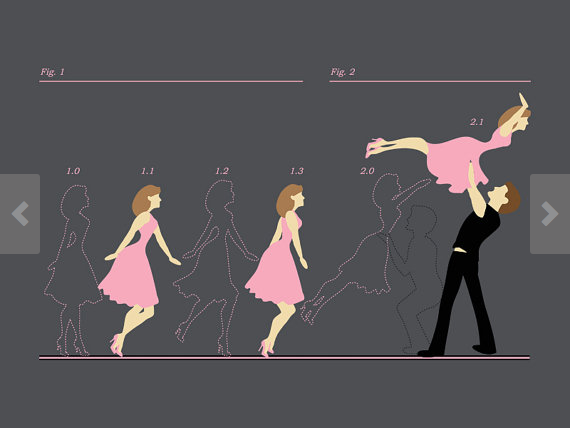
I’ve subsequently learned that latin dance exists in various social registers: you can dance salsa, bachata, merengue at family picnics, the same way people might polka or square dance—just like all the dances and balls in Jane Austen novels (what, isn’t that everyone’s frame of reference…?), latin dancing can be, simply, a fun, shared skill that allows friends and family to mingle, move, and enjoy some music. Of course the main function of dances in Jane Austen is to facilitate courtship; and latin dance has a similar dimension. Except if The Pocket Square and I danced salsa at Pemberly the way we danced at my friend’s party, I would have been bundled into a carriage and sent off to a Swiss convent the next morning, while papa vowed never to receive me at home again, and mamma wept into her kerchief over my social (if not absolute) ruin. Latin dancing, done in a certain mood, is the realization of every dance-inspired fear for the morals of youth (or whatever) over the ages, from the waltz to the charleston to the twist, to Footloose, to Dirty Dancing. Let’s just say, that that night, no-body put Baby in a corner. In fact, I could say that as far as dancing goes, I had the time of my life.

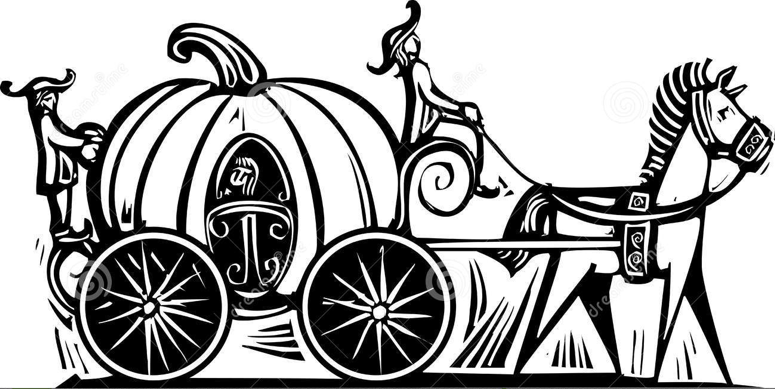
But—if I can rashly mix metaphors and movie references—it was just that kind of party—there was no breathtaking leap into a lift, a la either Swayze or Gosling. Suddenly the lights were on, everyone was leaving, the clock was striking 12 (well, 2) and like Cinderella, at a certain point I was summoned back to my coach, leaving Prince Pocket-Square calling after me through the crowd: “I’ll text you!!”

Of course I never heard from The Pocket Square again. No Hollywood/fairy tale endings here, I’m afraid—while I didn’t wake up the next morning sleeping in the ashes of the kitchen hearth, I didn’t wake up anywhere else other than my own perfectly virtuous bower. No royal proposals. No setting aside my career to be an entertainer at a Catskills resort. No harm done to familial honor. Probably fortunately for everyone, I ended up with nothing more than a fun story, and irretrievably-raised standards for men’s fashion (seriously guys, there are these things called tailors who could really, really help you out).

Most of all, I was left with the conviction that I ought to be dancing more, and dancing more salsa in particular. Yes, I actually do harbor a completely non-secret fantasy that salsa class will be the basis for a meet-cute to make Jane Austen and Hollywood proud. It could happen. That’s what dancing’s for after all. But never mind what motives got me through the salsa school door—as I’ll explain in my next post, I’ve found that I really love the physical and social challenge of learning a new dance form. The Pocket Square and I weren’t destined to be together, but unlike too many other frustrating, disappointing dates I’ve had, where Baby was, in fact, put in a corner, I came away from this unlooked-for encounter feeling pleasantly Cinderalla-ish—flattered, sought out, wooed—and inspired to try something new that makes me very happy.

Posted in Uncategorized | Leave a comment

On Coming in From the Cold (or: how I refuse to let the Abominable Snowman be a metaphor for anything)

Image

So if you were a fan of How I Met Your Mother (HIMYM), and a little obsessive-compulsive, then you will have seen it through its awful last season, to its final, limping, end. After which you may have participated in the online post-mortem, where there was much rending of garments, wailing, and gnashing of teeth over what the finale meant. Most commentary focused on the gimmicky resolution to the long-running show, which seemed to undermine or contradict the development of the characters—there was a rushed, poorly-thought-out quality to the episode that (surprise, for a finale) left most viewers unsatisfied. I found the finale of a piece with the whole of the last season: once the writers were committed to making that last season a kind of miniseries, they’d pretty much sealed all the characters in amber, stuck for months of viewing time in one last, drawn-out, weekend with the gang, after which everything would change forever—FOREVER. With the endpoint looming over everything, the writers had no choice but to favor, or languish in, schmaltzy sentimentality and recycled gags, rather than fresher material that would add depth to the characters (not to mention require the actors to work a little harder).

I was interested in the responses that focused on the change to the friendship amongst the five characters. These commentators saw the show as a reflection on their own lives, where they were at one stage of adulthood when they started watching, and grew with the characters as the show progressed, becoming, like Marshall and Lily, happily coupled up, with their parent-child relationship at the core of their social world. There was a bittersweet quality to these responses, lamenting the way that friendships just can’t last, priorities change, people move on, you can’t and don’t want to stay young and heedlessly unattached forever…

By contrast, I found myself just getting increasingly irritated by the show. I was supposed to be one of these viewers in the target audience, walking the same path from unfocused, rootless, single life to focused professional and personal life. When I started watching the show, while some characters were happily coupled, or happily single, Ted and Robin were the protagonists I related to; I shared in their hopeful quest to meet someone, to find love, to define their adult identities—and the appeal of the show, the energy which drove plot, tension, and humour, came from the ebb and flow of their successes and failures. I could relate to Lilly and Marshall retroactively and nostalgically—but it was the plight of Ted and Robin that made me feel some kind of included, commiserated, solidarity. They were muddling along a bit, but we were optimistic that everything would eventually work out all right for them (and hence for those of us identifying with them). After all, we know from the start that Ted must end up in some happy resolution, and assume (since it’s a sitcom, and not Scandal or Game of Thrones) that all the characters are moving towards a similarly-satisfying denouement.

Except, as better quality stories have always reminded us—we know nothing, and peg our fortunes to the trajectory of our fictional protagonists at our peril. In the last couple of years, I began to feel increasingly that Robin and I were being jerked around as the story line of the Strong Independent Woman (SIW) started to split away from the ideal resolution promised by the main plot. The happy vision of romance leading to peaceful domestic comfort was proving to be a fairly rigid one, demanding certain qualities for the would-be heroines that they just couldn’t—sometimes, weren’t allowed to—provide.

First, there was the problem of Robin’s self-sufficiency. After one particularly bad breakup, she’s devastated, and tearfully asks Ted what’s wrong with her, why can’t she meet a man who won’t let her down, who will stick with her, and whom she can trust and love? And Ted suggests that she’s too good at being herself—so competent and capable that most men, unable to do anything for her, can’t relate to her at all. (As when one’s mother says, “they’re just intimidated by you”—it’s an immense compliment, and yet of absolutely no comfort, because if the obstacle to happiness is what makes you you—then you’re quite stuck, aren’t you?) Ted means his explanation to be (back-handed) praise, because of course, both Ted and Barney admire, and yearn for her, because, or in spite, of her unshakable competence.

Then, after being sure her whole adult life that she doesn’t want children, Robin meets a man who makes her doubt that misguided belief (if a woman says she doesn’t feel a need for children, she just hasn’t met the right man yet, right?), and starts to panic a bit about her fertility. Rightly so, as it turns out she’s biologically excused from the potential of making a bad decision not to have children, by being unable to have them anyway. The SIW is going to stay that way, whether she likes it or not—and she loses the man as a result. By implication, we know at that point that she’s no longer a candidate for the Mother, because as much as Ted loves her, he longs for children—and the structure of the show, as one giant, extended flashback, has made it clear that he will have them. Somehow, partly because of her own choices, partly because of the manipulation of the plot, and partly because of the role she occupies socially, she can be cool Aunt Robin, but domesticity—tied directly to her fertility—is off the table.

But that’s ok, because Barney loves her anyway! Of all the characters in the ensemble, Barney is so patently a caricature, a campy cut-out of the selfish, childish, often-misogynistic “bro” that he can’t be taken seriously, even when he throws away the Playbook to signal his dedication to Robin—and yet, he’s the one who seems to be the best match for her. Importantly, he appreciates that she is more of a bro than Ted, with her focus, ambition, and preference for scotch. And unlike Ted, Barney doesn’t need her to give him children, he loves her just the way she is.

Until he doesn’t. After a huge, improbable, build-up, Robin’s and Barney’s marriage fails. What he liked about her was exactly her independence, self-sufficiency, and “masculine” self-sufficiency—and when she stays true to those qualities, he becomes peevish and resentful. Apparently, Robin might be excused from maternity as long as she takes on the parenting of her husband—something which, because she’s the SIW, she can’t and won’t.

Once divorced, Robin drops from the scene entirely, without much explicit reason (because, keep in mind, the writers are tying up loose ends in literal seconds in the last moments of the finale); the focus shifts entirely to the other four (and you realize it’s been shifting that way all season). Lilly and Marshall have it all—he’s a judge, they have their second child—they remain, as they have been throughout most of the series, Tolstoy’s uninterestingly happy family. Ted and Barney share the foreground—married, in Ted’s case, and happily reproductive in the case of both. Ted’s impossibly-saintly and wise wife bears him two children before conveniently dying of an unspecified illness (I don’t mean to be callous, but that’s about as much detail or sympathy as the show accorded her in the 10 seconds allotted to that plot point); Barney’s #31 of a month’s worth of hook-ups ends up pregnant, and though we never see her, and she’s given no other identity beyond #31, the resulting daughter is what finally breaks Barney of his selfish and misogynistic treatment of women (arguably, his ideas are just as simplistic as ever, though they’ve just manifested by sentimental, paternalistic idealization of all women as someone’s precious daughter).

While all this is happening, from the characters’ late 30s to their late 40s, Robin fades into the background. Lilly and Marshall describe sightings of her as rare, and when they occur, Robin is touchy and sullen—prompting the comparison of her to a rare and secretive mythical creature—not a unicorn, more like a Yeti. In montage, we see that in fact, Robin is off doing all sorts of Impressive Things—she becomes a Canadian-American Christian Amanpour, providing important exposés and coverage of world events. But Robin is cut loose from the others, who all get to have children, and get to stay together as friends, while, as the SIW, she is off in some undefined unexamined social wilderness, made figuratively monstrous by her singleness and childlessness. It’s only once Ted’s kids are safely into adolescence, and the fecund goddess-mother is killed off, that Robin returns—because Ted realizes that she’s the one he’s loved and desired all along. Of course, when he shows up to woo her with the blue french horn she is available, amenable, and grateful? relieved? And they all live happily ever after (except for the expendable Mother, and #31).

Hmm. Do you think I’m reading too much into all of this? I guess I’m not supposed to pay that much attention to Robin’s situation, nor take it so personally, because, presumably, I’m supposed to have ceased relating to her character at some point in the past—viewers like me, maturing with the characters, are supposed to have had a similar trajectory in their lives, from lost singleness into domesticity, and the community formed by family units. Except, like Robin, there are those of us for whom that trajectory just doesn’t work out that way—and we don’t appreciate the suggestion that our path inevitably leads us to the periphery, to become supporting characters who can provide useful plot development, but who are not otherwise central to the narrative.

I know it’s just a silly sitcom that jumped its shark a long time ago, and the finale was a narrative hash for all kinds of reasons. I also know that I mustn’t take pop culture so seriously—it’s really bad form to, you know, think critically and point out undercurrents of patriarchal and heteronormative bias that pervade popular culture and nudge us all to make similar choices about careers and relationships (oops, do excuse me, my ideological slip is showing…). But those undercurrents are there!* Despite all sorts of overly-enthusiastic lists of “why it’s great to be single”—we SIWs are under a lot of pressure not to be—because if we don’t overcome our singleness, where will we fit? No children, no partnership—to whom are we connected?

HIMYM’s facile, sexist, answer, apparently, is that the SIW/Yeti is connected to no-one. She exists, but in the parallel dimension frequented by fairies, ghosts, abominable snowmen, and other cryptids—no-where where nice, respectable middle-class folk would ever go. Except such an answer is nonsense, and completely undervalues the potential for a rich, generous, connected existence, which is the actual experience of most of the SIW’s I know, myself included. Being single may be a temporary or a permanent state, but either way, being single means neither that we are unsuited for, nor uninterested in, nor excluded from, any kind of “normal” or happy life—we just learn to define those terms in a much broader (I think, more interesting) way.

The HIMYM finale was an aggravating failure of narrative, social, and political imagination. The finale I would have liked to have seen would have been the set-up for a spin-off series about Robin’s life: her grief and dismay when her fairy-tale (?) marriage falls apart, and, instead of enjoying the security and certainty (the restfulness) of being a wife, she finds herself single again; her bewilderment at her married friends, who have turned inwards towards their children and one another, and who seem to have no time for the outside world at all, let alone her; her resolution to just get on with it anyway—to achieve, create, and change through her work, to travel, explore, live; her delight at her ability to build an amazing family for herself on her own terms (parents, siblings, friends). Maybe she finds a new love-interest; he might have kids of his own from a previous relationship—which is cool with her because she likes being Cool Aunt Robin—or he might not; he will definitely and conveniently have a flat (a loft) in London and know lots of interesting people there (because he will, apparently, be the hot English photographer from House of Cards), which will be a nice contrast to her cozy retreat in the south of France. She will occasionally be very unhappy; she will often be overcome with gratitude and amazement at how happy and full her life has turned out to be. She will absolutely not spend a single moment languishing in some culturally-imposed fallow, cryptozoological purgatory of spinsterhood; if anyone, even her best friends, ever uses the word Yeti (or similar) in her presence, she will throw her whiskey cocktail in their face—then laugh about it afterwards while she watches Hot English Photographer make her a steak; and if that ridiculous Ted Mosby (trying to repress his own grief at the loss of his very lovely wife by reverting to a simpler, idealized romantic opportunity that he lost a long time ago) shows up outside her window expecting her to drop her knitting and rush into his arms—he won’t find her there, because she will be out living her life.

That’s the finale I would like to see.


*The Madonna/Whore representations of the Mother and #31, not to mention all of Barney’s “conquests” over the years was pretty consistently insulting too, especially since the viewing public seems to accept and endorse those roles with no critical examination at all….

Posted in Uncategorized | Leave a comment

On Excess (Or: The Problem of Shimmying in Public Past the Age of 35)

Image

It’s one of the great pleasures/curses/ironies of my life that I was too shy and self-conscious to do a lot of things when I was the age when society allows or accepts your doing them, and am only confident and unconcerned enough to do them now that the world looks on such activities with disapproval and discomfort. Nowadays, I’m supposed to possess a certain matronly gravitas which would have me going on guided educational tours, volunteering as a docent at museums, subscribing to a matinee program at the ballet, and knitting slippers—all productive, improving past-times that I would totally do (or have done), and which don’t interfere with a decent, disciplined 9.30 bedtime. What I didn’t or couldn’t do when I was younger but that I really want to do now, and no longer am supposed to: scramble over rocks; do anything remotely associated with gigs, including using the word gig; swear impressively; dye my hair blue; stay up past 11 to go dancing in night clubs.

The last one poses the greatest dilemma. I love dancing of all kinds, ballet, classes at the gym, salsa, what wikipedia calls “disco”; and though I’m a reasonably social person, and, in fact, have met a lot of my friends at dance classes—I can’t find anyone to Go Out Dancing with me for love or money. When I was in my 20s, I was the one making up excuses about staying home with my cat and my research papers; now I’m the one optimistically carrying glitter around in her purse just in case the night comes when we overcome the myriad logistical (trivial) and social (significant) barriers to staying up past our bedtimes to dance.*

Part of the difficulty isn’t actually the dancing itself, it’s everything else we’ve put in its way. It used to be that dancing was a normal thing for people of all ages to do; there was room for it throughout people’s lives. But somehow everything has become so hectic and over-scheduled—with our unwitting complicity—that frivolities like dancing just don’t fit into regulated, working life. For me, it never has—when I was 18 and moved from the small town to the big city for university, and could finally go to the clubs and be a part of the scene, I was dismayed to learn that no-one went anywhere before 10, or, better 11. Why? Why must it be so late? Is it some kind of status display? (“I’m so glamorous I don’t have to get up before noon.”) Or a gesture of defiance? (“A job that starts before 10am, not to mention the work-week imposed by the industrial revolution, are for mindless proletariat slaves! Prove to the bourgeois capitalists that they don’t own your time by living on 4 hours of sleep!”) When I was a hyper-vigilant, overly-responsible student driven largely by a fear of failure, I couldn’t deal with the late hours. And now that I’m a hyper-vigilant, overly responsible worker largely driven by a fear of getting into trouble and failing to save enough for my 401k, thereby dooming myself to a retirement of poverty and desolation, I still can’t. My friends and I are all professional women (see “proletariat slaves,” above) who take it for granted that we must put in long hours at the office, take our work home with us on the weekends, get our medically-recommended allotment of sleep (with pillows slightly elevated to discourage puffiness around the eyes), and keep up with a strict exercise regimen that has us at Our Lady of Perpetual Vanity every Sunday at 9 am.

All facetiousness aside, there’s no doubt that we have responsibilities now that we didn’t then—never mind our jobs, more importantly there are children and, increasingly, aging parents who need us more than the dance club does. Even so, while we may not be able to go out a lot, staying up late is really just a scheduling problem—if we can manage everyone else’s productivity and still get ourselves to the airport at 5 in the morning for the flight to the meeting, and to the gym/dentist/ballet (matinee) on time, we can get ourselves to a bloody dance club a few times a year. If we don’t, it’s not being crazy-busy that’s the problem.

You know those twee British series set in the idealized, pre-WWII past that we all stay home on weekend evenings to watch instead of going out dancing? Ever notice just how all our romantic heroes and heroines meet in those stories? They dance—sometimes at events where their married friends, even parents, are also dancing, because there was once a time when everyone agreed that dressing up, going out, and socializing through music and dance was an acceptable way to have fun. But somehow, for many straight, white people under the age of 70, the meaning of dancing, its social function, and its form, has shifted greatly, so that we think it’s only something that the youth get to do, (while we sit at home and watch celebrities our age do it on tv)—and that it’s wrong, somehow even embarrassing, to dance if you’re over a certain age (unless you’re a fading celebrity, in which case you may dance on tv to pay for retirement). Our collective reasoning about this is, when you examine it closely, no reasoning at all. Our disapproval, and downright discomfort, about the older dancing body, is based on some dim idea that it’s inappropriate (that fantastic catch-all word we use now when we can’t explain why we think something is wrong)—even vaguely immoral. But why?

It seems necessary to implicate the 60s in this, thanks to that era’s inclusion of dancing in the anti-establishment counter-culture: dancing became unstructured, fueled by intoxication, and overtly sexual (while also less social, because less dependent on a partner). The first attribute poses an obstacle to would-be dancers of any age—people just don’t get formal lessons anymore in any style of dance, especially not the free-form moves done at nightclubs. And even though the whole point of throwing off the oppressive chains of old-fashioned social rituals like dancing was to just do your own thing–it turns out that many people actually hate doing their own thing.

There are two ways to deal with this problem—don’t dance at all, in which case you can spend a whole lifetime just lurking around in bars with a beer in your hand mocking people who do dance; or, do something to allow yourself to dance while not minding what other people might think. It’s long been the case that, in order to dance well in a club (or, importantly, feel like you’re dancing well), many people drink or take something else with disinhibiting properties; and I think it’s the association between certain forms of chemical excess and dancing that is a partial factor in our disapproval of the latter for older people. The 60s were successful enough that we’ll grudgingly allow younger people the social space to indulge in this form of excess, but the capitalist establishment has prevailed in requiring most people to be sober enough to show up for work on Monday morning—so some vague but powerful age cut-off persists to keep everyone in line.

But I’m not taking on all of capitalism today, and we can talk about selling out elsewhere: I just want to go dancing from time to time AND still show up to play my establishment role on Monday—and for some reason, the fact that I’m not 28 makes that proposition not just logistically difficult, but weird. And I suspect that what’s really at issue here has nothing to do with disinhibiting chemicals and everything to do with the problematic tension between excess and aging.

Because obviously, you can (and in the case of Zumba, should) do any kind of dancing perfectly sober, if you want to. And while, when you’re 25, you might be too self-conscious to dance, well, consciously—what I’ve happily found for myself is that I just can’t be bothered to be as inhibited as I was when I was 25, and don’t actually need to be completely sozzled in order to get up and move. And I prefer it that way: while I’m making the argument here that we should dance if we want to, I readily agree that there comes a time in one’s life when the cost-benefit ratio tips, so that being hung-over for half your weekend is just no longer a tolerable part of the dancing experience. Importantly, however, the equation where dancing=excess=being wasted is a false one, a red herring, if disapproval of tippling is what’s at issue (because, judging by the way we all joke about preparing for nor’easters by stocking the liquor cabinet, we older people are all temperance crusaders….). While drinking (or using other substances) can certainly be a problem, it’s not the problem when it comes to older people wanting to dance.

If you take alcohol (etc.) out of the equation, you end up with simply this: dancing=excess; and it’s really the latter that prompts the disapproval, in the absence of a close examination of what “excess” is. I suspect that “excess” means “having fun doing what you want, and having the bad taste to let the world see what you’re doing.” I’ve found that someone my age—that is, not 20, not even 30—is supposed to have more limited scope for our excesses, and much more sedate notions of fun. We’re not supposed to want to go dancing. I think people my age are not supposed to want all kinds of things that we want regardless—at a certain point, I’m given to understand, you’re just supposed to give up wanting. And this is not just a message I’m getting from Society in the abstract–we’re the ones buying into it, abiding by it, being cowed by it. One friend my age said recently, by way of dancing, sequins, and glitter, though she could have been talking about every other kind of moral turpitude: “Of course, that’s all over now.” Another friend, with no little sanctimony, actually scolded me for wanting to go dancing—such things should be beneath the dignity of someone like me, he said. Someone like who? I wanted to know. Where do we get the idea that at some arbitrary turn of a calendar page, we have to hang up our dancing shoes, put on a lumpy oatmeal-colored cardigan, and pick up our knitting while sitting out our turn at cribbage? (which, by the way, was how I and some of my grad school friends spent the ages of 24-26).

One never wants to be ridiculous, of course, nor does one wish to be seen anywhere too terribly infra-dig. But one doesn’t want to satisfy the world’s sanctimony either, at any age. Nor does one want or need to be governed by unexamined notions about propriety, that in turn are based on old-fashioned, biased, assumptions about class, sex, culture, behavior, and age. Sanctimony, in this case, comes from a prudish discomfort with the experience of pure, embodied, physicality that dancing provides. You’re allowed to experience this physicality as an athlete, because when you’re running, or practicing yoga, or taking a nice, structured, dance class, any potentially excessive pleasure you take from feeling your body move is discreetly camouflaged under a public performance of effort, suffering, self-sacrifice, and calorie-crushing discipline. But dancing is undeniably about nothing other than feeling good while enjoying what your body can do (often with other people)—and the connection to sex, and non-productive gratification is a little too overt for us to tolerate. Dancing does not have to be as inherently sexualized as it’s often presented in popular culture (Miley, please, just stop), but sexuality is undeniably part of the physical experience of dancing, even–yes–in the aging body. Oops—did I just make everyone uncomfortable? Exactly. So I’ll say it again—to dance is to allow the free reign of a variety of energies in the body, some (but not all) of which might include libidinal energy. To which we ought to say, so what?? Taking pleasure in one’s own physical movement on a dance floor, at whatever age, is a long way from…what exactly? Why is it acceptable for a bunch of 40 year old women to shimmy and grind in a Zumba class (because they do exactly that, and love it) and yet so mortifying and threatening if they are seen attempting similar moves outside of it? Are there not laws to contain the worst case scenario, whatever it might be? Just what are we afraid will happen, on the dance floor or off of it, if older people dance?

There are no rational answers to these questions. None. All that I can come up with is that “excess” is an epithet meant to condemn an unseemly display of physical liveliness and enjoyment (defined as thoroughly and uncomfortably as you like) when applied to the older dancing body. Fiddle-faddle. What puritan nonsense is that? The rules are the same no matter how far past 21 you might be: as long as you can physically manage whatever constitutes your personal ideals of fun, you should continue to do whatever fun, excessive thing you damn well please. You want to talk about gravitas, surely it’s terribly infra dig (not to mention unsupported by health research) to surrender your vitality in favor of performing some implied role of decrepitude that we’ve inherited from an era when the life expectancy was a good two to four decades shorter than it is now. If we can expect to live to 80 or 100, that’s a whole second lifetime ahead of us—and that’s a very long time to do nothing more outré than wearing cardigans and—heaven help us—playing cribbage (unless you love it, in which case, peg out and be proud!). As the saying goes, “youth is wasted on the young”—it’s supposed to be a curse, but I see it as a blessing, to cherish your vitality more, the closer you get to not having it. Maybe if I’d spent my 20s in more typical dissipation, I’d be jaded by it all, and agree with my friend, that “of course, that’s all over now.” At my terribly advanced age, I’m not craving dissipation and I really don’t want to corrupt any youth.** But I’ve still got decent legs and cooperative feet, and I just want to put on some glitter, and sequins, and dance.  Who’s going to stop me?

*Because one is not, mercifully, doomed to a dance-free existence. I’ve somehow ended up stuck in a social circle where the only excesses are self-denial and responsibility (yes, there is some self-selection on my part). One source of exasperation for me is that (perhaps you all know this?) people dance all over the damned place, heedless of whether they’re cool, or pretty, or young enough (because: who cares??). Nightclubs are their own thing, but then there’s contra-dancing and ballroom, and, my new favorite, latin. So in fact, after this whole diatribe, the fact is that we could be dancing if we really wanted to.

**Some fears seems to be that an older person will try to 1) act like she’s 25; 2) surround herself with 25-year-olds; 3) date a 25-year old. I guess that does happen—though most typically, the preferred age seems to be 28, and that’s a whole other issue that shouldn’t have anything to do with dancing. Personally, all things considered, I’d much rather dance as far from the youth—particularly, ones I might be professionally responsible for—as possible.

Posted in Uncategorized | Leave a comment

On Doing Nothing at an All-Inclusive Resort (and feeling slightly bad about it): The Follow-up Critique

Image


Let me be very clear—I had a fabulous time on my beach holiday. I soaked up the sun (to the point of getting stupidly burned, which, a week later, garners all kinds of compliments about how healthily-tanned I look, but which I’ll pay for when I’m 80 and presenting an award at the Oscars). I soaked up the food, the drinks, the hedonistic laziness. But, me being me, the part of my brain that is hardwired to be anxious, vigilant, and tinged with puritanical/socialist guilt about wallowing in the hedonism industrial complex, couldn’t help making a few observations:

To stay at an all-inclusive is a bizarre experience. A and I can say to our friends, we went to the DR, like we did something daringly exotic, like we have some claim to the country, like we know the place somehow.

Really, we could have been anywhere.

If you’ve never been to an all-inclusive resort, it’s like a cruise ship, but on land. Or, it’s like a Disney theme park, an “imagineered” version of the DR (or Mexico, the Bahamas, wherever), where the “environments” and “experiences” are all artfully stage-managed, and the machinery that keeps it all running is camouflaged behind carefully-designed facades. Or, if you’ll excuse the reference, it’s like belonging to one of the Houses of Westeros (A, I’m allying us with House Targaryen, if you don’t mind). The one thing an all-inclusive resort is not like is the place it’s in—designed, landscaped, and totally controlled, the resort is a reflection of what tourists want (or have been taught to expect), safely and artificially removed from the real food, culture, economy, language—even the land itself. Huge swaths of country’s beachfront have been given over to the resorts, each one its own compound with high walls (with razor wire on top), gates, security guards, and IDs for everyone (including the guests, who usually get banded with festival wristbands in the resort’s colors, stamped with the resort sigil)—all the resorts mass together to form one large meta-compound, catering to hundreds of Europeans, Canadians, and Americans, all dependent on the service of hundreds of others, recruited from the local population.

This army of retainers (the vocabulary of a medieval or fantasy court just comes naturally in this case, for some reason) was responsible for keeping our rooms clean and climate controlled; keeping us fed with a decadent breakfast buffet, barbecue lunch buffet, and dinner at a half-dozen different restaurants, each offering its own cuisine (French, Asian, American, Italian, Mexican—but not Dominican); keeping us safe, by guarding the compound gates to exclude anyone not paying, or being paid, to enter; keeping us entertained and diverted; keeping us complacent, with professional politeness and flirtation.

And, no small task of its own—the staff kept us hydrated. The resort had some kind of water filtration, so all of the food (of very good quality) was suited to the delicate, overly-clean, antibiotic-resistant digestions of us Northerners. But the drinking water was all bottled. As fit urban women, used to carrying our grown-up sippy-cups with us everywhere; and as tourists, eating everything that wasn’t nailed down, and trying not to rely only on frozen daiquiris as a source of fluids, A and I went through a lot of water—a dozen 1/2 litre bottles of water a day between us, easily. We tried not to think about where all the plastic was coming from, or going (along with all the beach towels, and uneaten food, and plastic cups for our daiquiris…). In other words, all-inclusive resorts are mind-bogglingly resource-intensive, and we’re not meant to wonder, or care, where all that materiel comes from, and at what benefit or cost to the local eco-system.

I’m not sure where the Dominican staff actually live—the resorts might provide dorms. But every morning, between 8 and 9, as we took our coffee on our Deluxe Pool-View Deck, we would watch as the staff, dressed in task-specific livery, flowed outward from their headquarters, which was carefully hidden away from tourist view. The gardeners who groomed the trees and shrubbery, and raked up excess seaweed washed up on the beach each morning (what do they do with it…?) wore green scrubs. The maids were in pink dresses, the bar tenders all in white polo shirts, shorts, and sneakers, the waiters in white high-necked jackets. They’d stroll past us in twos or threes, to start what was, for many of them, a 12 hour day, part of a 10-day-on, 4-day-off rotation. Some of the staff spoke excellent English; many hardly spoke any, but seemed eager to practice with us, and pleased when we tried to use our very limited Spanish (hola, gracias, dos daiquiris y dos aguas por favor). Do the resorts provide language instruction for the staff, or is it up to them to learn as best they can on their own? Would it be going too far to wonder if the resort industry kind of likes the staff to have limited language skills, to keep them more dependent, and less ambitious…?

And I wondered, often, what the staff must think of us. Everyone who helped us—who served us— was unfailingly polite and friendly; the men made sure to flirt with us at every opportunity, and we were thanked repeatedly for visiting their country. I felt genuinely welcome, and I believe that a lot of the friendliness is sincere. But surely it’s also at least partly a performance: this is what you say and how you act to make the tourists contented. Maybe it’s symbiosis: tourism is obviously a vital part of the economy in the Dominican Republic, and as much as we might be exploiting the DR’s resources and people, they’re exploiting us right back, and have every right to do so. Sometimes—taking the cruise ship comparison to its logical conclusion, as envisioned in Wall-E—I suspected that we all-inclusive tourists function as a kind of docile herd or cash crop that needs a lot of attention and tending; our caretakers might feel some affection for us, but occasionally? often? we must simply represent work that needs to be done, in order to keep us well-cultivated, organized, and productive (buying the vacation package; buying jewelry and bikinis and truly extortionately-priced sunscreen in the shops; tipping the maid who brings us extra towels; tipping the beach waiter who chats us up and insists that Boston/Montreal/Moscow/Copenhagen is his favorite city in the world, and asks us how come our papi chulo‘s aren’t on vacation with such lovely ladies).

I wondered especially what the staff thinks about all our relentless eating and boozing. As with cruise-ships, and as with grazing herds (really, the critique in Wall-E is pretty scathing, and yet the film’s large audience just doesn’t seem to take it personally), you can ingest and imbibe every waking minute if you want to. Breakfast starts at 8, and snacks end at midnight; you’re provided with unlimited rum and champagne in your mini-bar, and the bars open at 10 am. Many people move right from coffee and bacon to cocktails (or just have mimosas with the coffee), and continue to drink, eat, and doze all day. We hardly noticed anyone rowdily drunk—the combination of heat, food, alcohol, and reclining deck chairs kept everyone well-sedated (and sunburned). But how they all managed to keep going was a mystery. And if it sounds like I’m spending a lot of time on the role of drunkenness at these resorts—you haven’t been to one. People LOVE the whole conceit, that somehow the food and drink are endlessly illicit, while also bottomlessly available. Of course, the whole point is that you do at the resorts everything you mustn’t do at home—except of all the sins one could attempt in an anonymous vacation setting, no-one really gets much past gluttony. (There are “adults-only” resorts, with names such as Breathless, Hedonism, Secrets, the ads for which suggest that the environment will facilitate a lot of sex, possibly with strangers. Maybe people get a little more sinful in such places, but I’m betting that, with the same tempting orgy of food and alcohol on offer, they don’t).

Our fellow guests fascinated us. My dermatologist and fitness instructors would be horrified by the deliberately-abused skin, ranging from burned to well-cured, and the abundant fleshiness. (When do men give up, and just start walking with a backward lean to counterbalance their outsized bellies…?). There is some correlation between the choice of resort experience, and overall physical health, that medical science needs to investigate. The guests were overwhelmingly white; additionally: 1) single women generally travel in groups of 2-4 (I’ve done it solo, I know other women who’ve done it, but we’re rare creatures, and men absolutely don’t go by themselves); 2) straight men don’t go to all-inclusives without women—every man (except a few gay couples) was participating in a Family Trip, a Romantic Couples’ Getaway, or a Honeymoon. We theorized that while it’s acceptable for two straight women to travel together for a Girls’ Getaway, straight men won’t risk it, too afraid of being mistaken for gay by hundreds of complete strangers they’ll never see again (though, if it matters that much, and it shouldn’t—with those baggy beach trunks, no-one’s going to be confused); 3) white, North American men will not attempt Latin dancing and are no fun (fortunately, the resort provides male staff to get the ladies out for some bachata).

Many guests were there in groups—for weddings, family reunions, or as 2 or 3 couples traveling together. Each group would keep itself to itself—language was one barrier to socializing; a larger barrier was the astonishingly antagonistic, irredentist, competitiveness we all immediately developed over our beach chairs and shade. With more tourists than umbrellas to go around, people would attempt to claim chairs as early as 8 in the morning, leave them for hours, and expect to find the chairs vacant and ready when they showed up after lunch. A and I were having none of this—if we found chairs with no more sign of occupation than a couple of anonymous towels, we’d surveille the scene for a decent interval, then move in. When our fellow guests would waddle up to us 3 hours later and say, “Ve are sorry, but these chairs are busy. Ve hef left our towel,” we’d feign innocence: “Oh dear! Someone must have taken this spot before we got here—these chairs were empty when we found them!” Possession being nine tenths of the law, and the two of us politely but implacably installed in our shade, our foes were left to slog away to find shelter elsewhere. We were sworn at in several languages.

So: while all-inclusive resorts are luxurious, decadent, and relaxing, they are far from truly inclusive—installed in your little fortress of beach chair, inside a fortress of a resort, inside the larger fortress of the resort compound, you’re set apart from your fellow guests, from the people paid to serve you, from the culture that’s come to rely on you for the cash you represent. The experience doesn’t really bring out our best qualities: whether the resources are scarce (beach umbrellas) or abundant (liquor), resort guests consume, and even hoard them greedily. And so focused on getting our money’s worth of self-indulgence, we have no time or interest to spare for the other people around us, and the culture beyond the walls.

In the midst of comfort and self-indulgence, I’m bothered by all of this. And yet (did you know this is a confessional blog?), never enough for me to have surrendered my beach chair, and to have flounced out of the resort in a fit of marxist disapprobation. As I said at the start—I really, honestly had a great time on this recent trip. I might very well do it again. As a good friend once observed, if you’re overwhelmed by some problem (like your professional identity, like your nonexistent dating life, like winter), throw money at it. That’s what capitalism is for, after all. Throw money at a problem, someone will gladly catch it, and offer you frozen daiquiris, a fresh towel, and a spot in the sun in exchange.

Posted in Uncategorized | Leave a comment